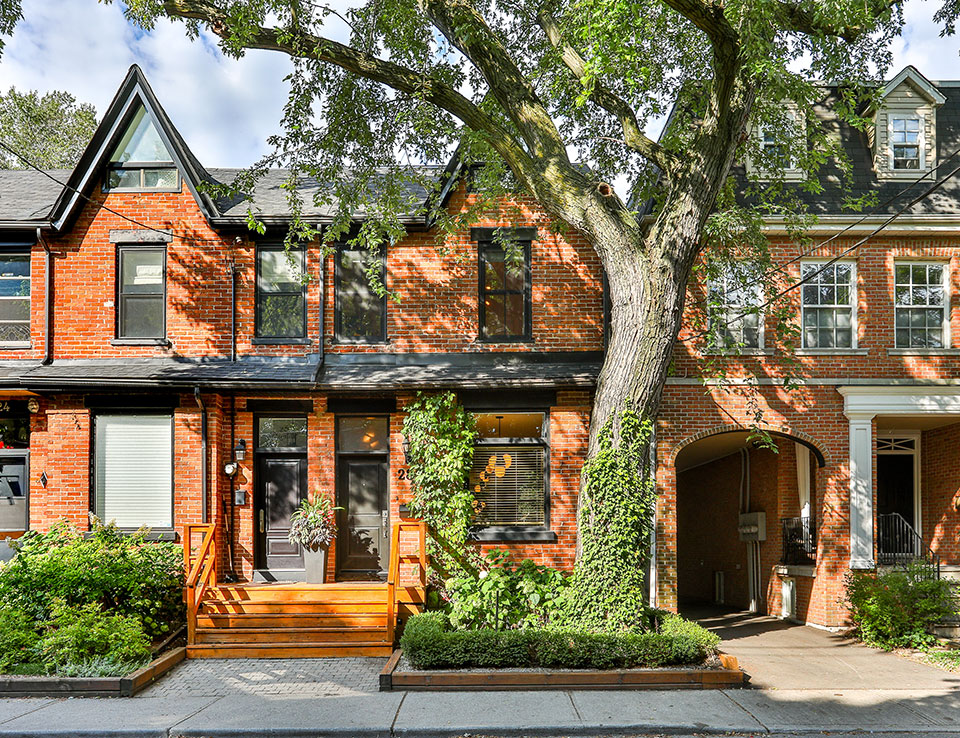
According to a March 2026 WOWA/CREA MLS HPI market report, the benchmark price across all types of homes in Toronto was approximately $1.07 million. For context, that’s well above what buyers are dealing with in Ottawa, where homes average around $640,000, or Calgary at roughly $580,000.
At that price level, the rate you lock in isn’t a minor detail – it’s the difference between a payment you can carry comfortably and one that keeps you up at night. Even a fraction of a percentage point compounds into real money over the life of a mortgage.
Current Mortgage Rates in Toronto
*Rates checked: September 30, 2026. Mortgage rates change frequently; confirm current rates with your lender before making a financing decision.
As of September 30, 2026, the prime rate published by Canada’s major banks was 4.45%. Prime is not the Bank of Canada’s policy rate: the Bank of Canada sets the overnight policy rate, while commercial lenders set their own prime rates, which are influenced by the central bank’s decisions.
For borrowers with variable-rate mortgages, changes in a lender’s prime rate can affect the interest rate charged on the mortgage. The effect on the monthly payment, however, depends on the type of variable mortgage and the terms of the loan.
Advertised rates tell you where negotiations start, not where they end. Your Annual Percentage Rate (APR) is the number that actually matters – it reflects the true cost of borrowing by folding in both the interest rate and any associated fees.
5-Year Fixed Rates
The 5-year fixed is the default benchmark for Canadian buyers, and for good reason – it gives you predictability. As of early September 2026, the best high-ratio (insured) 5-year fixed mortgage rate in Ontario is 4.09%.
Average conventional 5-year fixed rates across Canada, including Ontario, are running around 4.16%. If you’re going to one of the Big 5 banks specifically, Scotiabank currently offers the lowest 5-year fixed option at 4.24%.
Variable-Rate Mortgages
Variable rates move with the prime rate, which means they can go either direction. As of September 3, 2026, the best high-ratio 5-year variable mortgage rate in Ontario is 3.3%.
Among the Big 5 banks, RBC and Scotiabank are tied for the lowest 5-year variable at 3.65%. If you’re going variable, your budget needs room to absorb higher payments if the prime rate climbs – that’s not a hypothetical, it’s a condition of the product.
Factors That Determine Your Interest Rate
The rate you see advertised and the rate you actually get quoted are often two different numbers. Lenders price risk individually, and your specific financial profile drives that conversation.
Underwriters are looking at your credit history, your available capital, and how much of the home’s purchase price you’re borrowing. Every one of those factors shapes what they’re willing to offer you.
Credit Score Requirements
Your credit score is the first thing lenders reach for – it’s their shorthand for your repayment history. Strong scores generally open the door to the most favourable rates from prime lenders.
If your score falls below standard thresholds, you may find yourself looking at alternative lenders instead. Those institutions charge higher rates to offset the additional risk they’re taking on.
Down Payment and LTV
Your down payment determines your Loan-to-Value (LTV) ratio – essentially, how much of the home’s value you’re asking the lender to carry. A lower LTV is less risk for them, which typically translates to better pricing for you.
Canada’s minimum down payment follows a tiered federal rule: 5% on the first $500,000 of the purchase price, plus 10% on any portion between $500,001 and $1,499,999.
Types of Home Loans Available in Toronto
The Canadian mortgage market splits loans into two categories based on your down payment size, and which category you fall into determines whether you’ll be paying for default insurance.
That insurance protects the lender – not you – if you default. The premiums are typically added to your total mortgage amount and amortized over the life of the loan.
High-Ratio (CMHC Insured) Mortgages
A high-ratio mortgage kicks in when your down payment is less than 20%. These loans require default insurance, most commonly through the Canada Mortgage and Housing Corporation (CMHC).
Effective December 15, 2024, the federal government raised the maximum purchase price eligible for CMHC-insured mortgages from $1,000,000 to $1,499,999. That change matters a lot in this market – it means buyers in Toronto, ON can now purchase homes up to $1.5 million with less than 20% down.
Conventional Mortgages
Conventional mortgages require 20% or more down. Because you’re bringing more equity to the table, these loans don’t require CMHC default insurance.
For homes priced at $1,500,000 or more, there’s no insured option available at all. At that threshold, you’re putting down at least 20% and going conventional – full stop.
First-Time Homebuyer Programs in Ontario
First-time buyers in Toronto, ON have access to a few rebates and incentives worth knowing about before you get to the closing table. Ontario offers a provincial land transfer tax (LTT) rebate covering the full LTT amount up to a maximum of $4,000, which fully covers the tax on homes priced up to about $368,000.
To qualify for the provincial rebate, you must be at least 18 years old, be a Canadian citizen or permanent resident, and apply within 18 months of purchase. If you’re buying within the City of Toronto specifically, there’s also a separate Municipal Land Transfer Tax (MLTT) rebate of up to $4,475 – so eligible buyers can receive combined rebates of up to $8,475.
On the federal side, the RRSP Home Buyers’ Plan (HBP) lets individuals withdraw up to $60,000 – or $120,000 per qualifying couple – toward a down payment. The First Home Savings Account (FHSA) adds another tool, with a lifetime contribution limit of around $40,000.
As of March 12, 2026, a new federal First-Time Home Buyers’ GST/HST rebate on new-build homes is also available, offering eligible buyers up to $50,000 back on their purchase.
Frequently Asked Questions
Should I choose a fixed or variable mortgage rate in Toronto right now?
It depends on your risk tolerance and how much flexibility your budget actually has. As of September 2026, the best high-ratio 5-year variable rate in Ontario is 3.3% – lower than the best 5-year fixed at 4.09%. The catch is that variable mortgage rates typically move with a lender’s prime rate, which is influenced by the Bank of Canada’s policy rate. If rates rise, the impact on your mortgage depends on whether you have a variable mortgage with fixed payments or one with adjustable payments.
Fixed Payment vs. Adjustable Payment
“Variable” does not automatically mean “your monthly payment changes every time rates move.”
With a variable-rate mortgage with fixed payments, the payment can stay the same while the amount going toward interest and principal changes. If rates rise substantially, a borrower can eventually reach a trigger rate, at which point the lender may require higher payments or another form of adjustment.
With an adjustable-payment variable mortgage, the payment itself changes as the interest rate changes.
For buyers comparing mortgage options, the distinction matters. Don’t look only at the advertised rate; understand exactly what happens to your payment if rates move.
How much income do I need to qualify for a mortgage on an average Toronto home at current rates?
It depends on your down payment and existing debt. With the benchmark home price in Toronto at approximately $1.07 million, lenders will run your income against the Canadian mortgage stress test and weigh it against your other financial obligations. There’s no single answer without knowing your full picture.
How long can a lender hold a pre-approved interest rate for me while I house hunt in Toronto?
It depends on the specific lender you choose. Most financial institutions offer a set rate-hold period for pre-approvals, but you’ll want to check directly with your bank or mortgage broker for their exact timelines.
How does the Canadian mortgage stress test affect my buying power in the Toronto market?
It reduces your maximum borrowing amount. Lenders are required to qualify you at a higher interest rate than your actual contract rate – the point being to confirm you can still manage payments if rates rise. In practice, that means you may qualify for a smaller loan than the advertised rates alone would suggest.
What happens if I can’t afford my new mortgage payments when renewing my Toronto condo?
Contact your lender immediately. Depending on your situation, they may allow you to extend your amortization period to bring the monthly payment down, or you may need to look at refinancing. If neither of those options works, selling the property may be the path you’re left with.
What are the penalties for breaking a fixed-rate mortgage early to sell my Toronto house?
It depends on your lender and the specific terms of your contract. Lenders typically charge a penalty based on either a set number of months’ interest or an Interest Rate Differential (IRD) calculation. Review your mortgage agreement before you list – the cost can be significant, and you want to know what you’re looking at before you commit.