QUICK MARKET SNAPSHOT
Before we zoom into semi-detached homes, it is important to understand the broader market context.
Toronto Market at a Glance (December 2025 Data)
- Overall transactions down approximately 9 percent year over year
- New listings up modestly at 1.8 percent
- Active listings up 17 percent
- Average prices across all asset classes are down about 5.1 percent
- Average days on market up roughly 14 percent
- Total average selling time is now approximately 65 days
This is not a booming market. It is also not a collapsing one. It is a slow, selective, price-sensitive environment, where asset selection matters most.
Months of Inventory Tell The Real Story
Months of inventory, also known as absorption rate, answers one critical question: At the current rate of sales, how long would it take for everything on the market to sell if no new listings were added?
As of December 2025:
- Toronto sits at approximately 4.6 months of inventory
- This places the market firmly in balanced territory
For context, at the February 2022 peak, Toronto had roughly three weeks of inventory.
What is distorting today’s number? Condos. Condo inventory is high, and sales velocity is slow, pulling the overall average up. Low-rise housing is behaving very differently.
What Exactly Is a Semi-Detached Home?
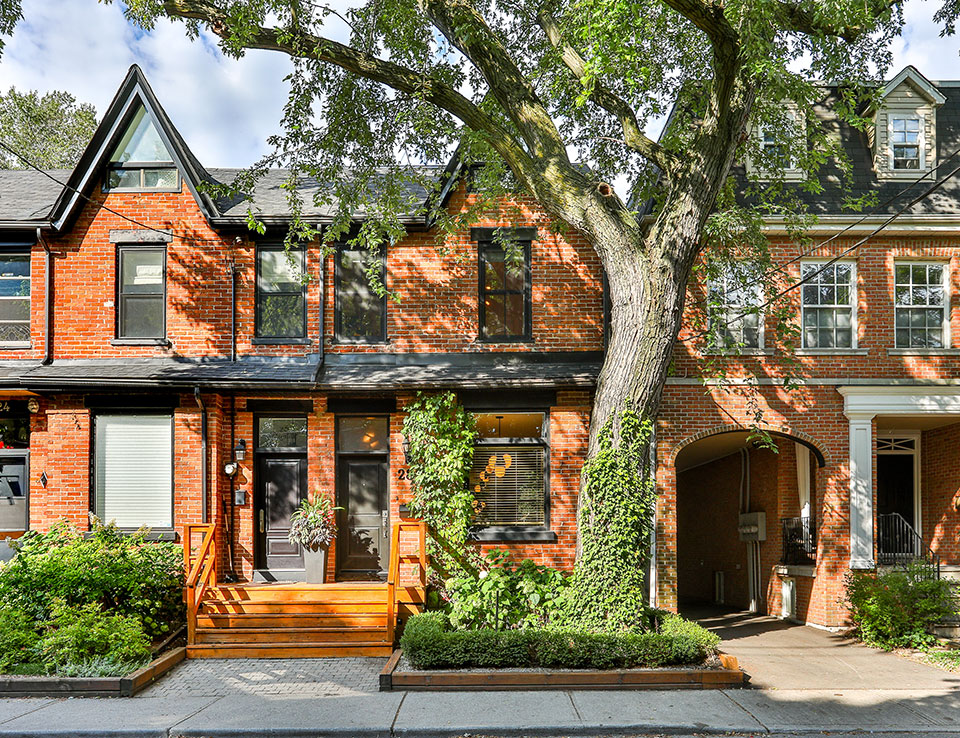
A semi-detached home is a freehold house that shares one wall with a single neighbouring property, not two, not stacked, and not vertically layered, and that distinction matters. Semis offer land ownership, no monthly maintenance fees, more living space than a condo or condo townhouse, and a lower price point than a fully detached home. For many buyers, this makes a semi-detached property the natural gateway into Toronto’s freehold market. The detail that often gets overlooked, and the one that underpins their long-term value, is that Toronto is not building more semi-detached homes. Supply is permanently capped.
Semi-Detached Performance Over the Last 12 Months
AVERAGE PRICE TREND
- December 2024 average: approximately $1.30M
- December 2025 average: approximately $1.12M
- Year-over-year decline: roughly 12 percent
Prices softened meaningfully in 2025, particularly after the spring market.
Sales Volume Trend
- December 2024 sales: 113
- December 2025 sales: 122
- Year-over-year change: up approximately 8 percent
A 10-Year Perspective on Semi-Detached Homes
SALES VOLUME (ANNUALIZED)
- 2015: 3,888 sales
- Peak (2021): 4,015 sales
- 2025: 2,539 sales
Sales volume is down roughly 35 percent from peak levels, reflecting affordability constraints and economic tightening.
PRICE GROWTH
- 2015 average price: $734,000
- 2022 peak: approximately $1.37M
- 2025 average: approximately $1.23M
That represents:
- Nearly 70 percent appreciation since 2025
- Only about 9.7 percent off-peak pricing
AVERAGE DAYS ON MARKET
- 2015: 14 days
- Peak market: 11 to 12 days
- 2025: approximately 21 days
Buyers are taking their time. Conditions are back. Due diligence matters again.
SALE PRICE TO LIST PRICE RATIO
- 2015: 105 percent
- Peak frenzy: 113 percent
- 2025: approximately 105 percent
Competitive, but not rational.
The Most Expensive Semi-Detached Neighbourhoods
These are areas where semis exist, but detached homes dominate pricing.
- Rosedale Moore Park / Average price: $3.1M
- Yonge & St. Clair / Average price: $3.0M
- The Annex / Average price: $2.2M
- Palmerston Little Italy / Average price: $1.7M
- Trinity Bellwoods / Average price: $1.5M
These markets tend to hum along rather than surge.
Where Semis Still Trade Under $1 Million
Where semi-detached homes still trade under $1 million is likely where much of the 2026 opportunities lives. These neighbourhoods that allow buyers to exit condo living, own land, remain connected to transit, and purchase below the powerful psychological million-dollar threshold. Areas such as Clairlea Birchmount, Glenfield Jane Heights, Humber Summit, Parkwoods Don Valley, Downsview, and Weston Pelham Park continue to offer this combination of affordability and functionality. These are not fridge locations on the edge of the city, but early-cycle markets where value remains accessible and long-term upside is still very much in play.
Bedroom Count Matters More Than You Think
Average semi-detached prices by bedroom count in 2025:
- 2 bedrooms: $1.00M
- 3 bedrooms: $1.17M
- 4 bedrooms: $1.35M
The jump from two to three bedrooms is significant. While two-bedroom houses can be charming, three-bedroom homes tend to sell faster, appeal to a broader buyer pool, and perform better than over the long term. For buyers who can manage the stretch, moving into a third bedroom often pays offer later in stronger resale value and greater marketability.
Parking Still Commands a Premium
Across all bedroom counts:
- No parking: $1.22M average
- One parking space: $1.33M average
That $100,000 delta aligns with real buyer behaviour in 2025. Parking is not optional for many households.
Why Semi-Detached Homes May Be the 2026 Winner
Semi-detached homes may emerge as the 2026t winner not because the market is set to explode or because prices are poised to skyrocket, but because the fundamentals quietly line up in their favour. Supply is capped, entry-level demand remains strong, condos continue to absorb excess inventory, and detached homes remain out of reach for many buyers. Semis sit at the intersection of affordability and scarcity, and in balanced, slower markets, it is often the asset that still makes financial sense that ultimately outperforms.
Final Takeaway
If you are a buyer, 2026 may be less about timing the market and more about choosing the right asset. If you are a seller, understand where demand will re-enter first is critical.
Semi-detached homes, particularly in emerging or undervalued neighbourhoods, may quietly become the most reliable performer in Toronto real estate this year.
What To Do Next:
- Watch the full YouTube episode for charts & neighbourhood information
- Review your buying power relative to freehold options
- Stop looking only at headlines and start looking at fundamentals
- If you already own a semi, reassess its long-term positioning
- If you are stuck between a large condo and a small freehold, run the numbers carefully
And if you want help breaking down what this means for your specific situation, that is exactly the kind of conversation we love having.
The market may be quiet. Opportunity rarely is.
Ready to take the guesswork out of your next step? Book a strategy consult with Fox Marin.
Contact Us (We’re Nice).
Fox Marin is recognized as one of Toronto’s most trusted real estate teams, with 550+ five-star Google reviews, more than 1,000 successful transactions, and over $700 million in sales volume.
(*Source: RE Stats Inc. / Loft47, Jan. 1, 2018 – Aug. 31, 2026)
—
This article was written by Kori Marin, a Toronto Broker & Managing Partner at Fox Marin Associates. For high-energy real estate aficionado Kori Marin, a well-lived life is achieved by maintaining an “all-in” attitude that realizes every last ounce of one’s full potential. This mindset has driven successful results in every aspect of her life – from her corporate sales and account management experience to her international travels to her years of fitness training and leadership – and is the hallmark of the exceptional work that she does on behalf of her clients in the residential real estate sector in downtown Toronto.