Is Little Italy Cool Again? What College Street’s Comeback Tells Us About the Neighbourhood
When was the last time you actually went out in Little Italy?
For a few years, Little Italy stopped feeling like the place to go and started feeling like the place people remembered going.
College Street between Bathurst and Ossington never stopped being one of Toronto’s great neighbourhood streets. The houses were still beautiful. The patios still filled up in summer. Café Diplomatico kept doing what it had done since 1968. And when Italy played soccer, the flags came roaring back out.
But one of Toronto’s centres of gravity had removed. Ossington became the new destination. Dundas West became the new spot to hang out. Geary became the place somebody told you about before everybody else knew. College Street, meanwhile, seemed somewhat stagnant, coasting on its reputation.
Then something changed.
Between early 2025 and the spring of 2026, roughly a dozen noteworthy restaurants, bars and cafés opened along about a kilometre of College Street. More interesting than the number is who opened the operators connected to Dreyfus, Bernhardt’s, Pompette, Bar Volo, Big Trouble, Lucia and some of Toronto’s most established hospitality names.
One great opening can be luck. A dozen experienced operators making essentially the same bet signals something. And if you are trying to understand where a Toroto neighbourhood may be heading next, those signals are worth paying attention to.
30,000 people saw this, and apparently everyone had something to say. The comments are better than the reel.
Little Italy Never Lost the Bones
Before talking about what has changed, it is worth remembering what didn’t.
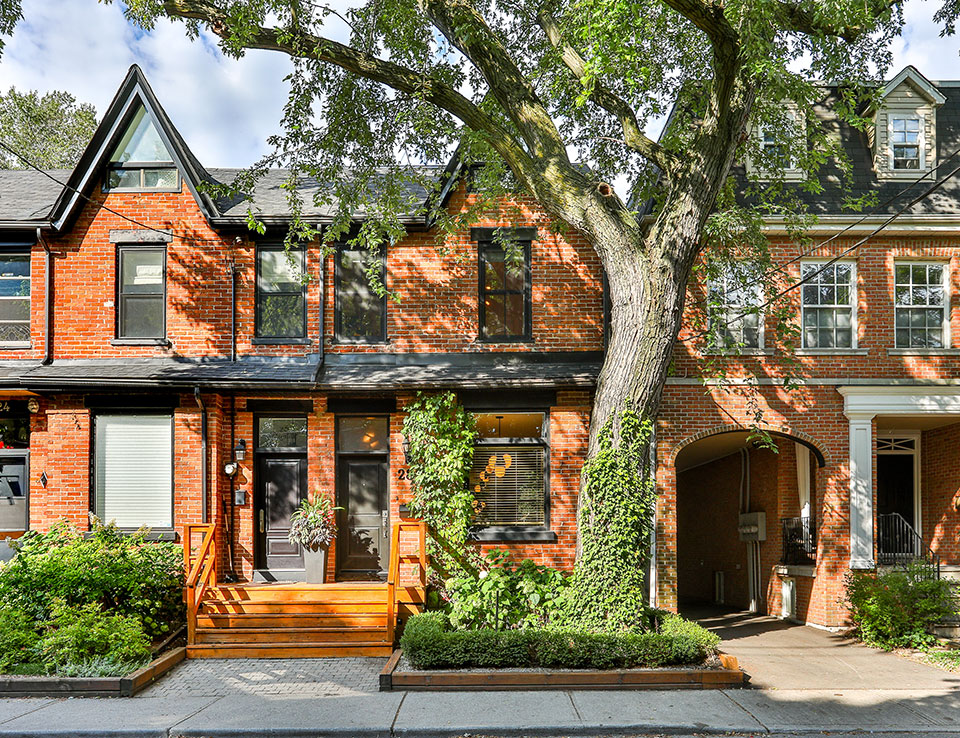
Little Italy and the residential streets around College have always had an usually strong urban foundation. Palmerston. Euclid. Manning. Clinton. Grace. Beatrice. These are some of Toronto’s most recognizable residential streets: rows of Victorian and Edwardian houses, mature trees, front porches and the kind of density that somehow still feels residential.
College Street puts restaurants, cafés and transit at the doorstep. Downtown is close. Trinity Bellwoods, Bickford Park, Kensington Market and transit are all within easy reach.
The neighbourhood already had most of the ingredients people spend years trying to find in Toronto. What had gone quiet was College Street itself. And that matters more than people sometimes realize.
Choosing a neighbourhood is rarely just about the house. It is the coffee shop you walk to in the morning, the park you use on Sunday, how easily you get downtown and whether there is somewhere good to go for dinner without getting in the car.
Little Italy already had the character, housing, transit and location. Now College Street is catching up again and leading the charge.
Then the Operators Started Arriving
Walk west along College today, and the change is hard to miss.
Right at Bathurst, at 432 College, Lonely Diner has taken over the former Mars Food space. The team behind Big Trouble reimagined one of Toronto’s oldest diner addresses as a cocktail bar and restaurant.
Lonely Diner, 432 College Street
Further west, Hermant Bhagwani turned his Oro space at 501 College into Naari, bringing live-fire Thai cooking to the strip.
Susie’s Rise and Dine gave the neighbourhood a new all-day diner option. N.L. Ginzburg, from the team behind Dreyfus and Bernhardt’s, came with an Italo-Jewish menu and quickly became one of the city’s most talked-about openings. Next door, Aangan added modern coastal Indian cooking.
Susie’s Rise & Dine, 539 College Street
Aangan, 556 College Street
Then there is Curva Sud, a proper Italian espresso bar. Bitters and Bloom, a tucked-away cocktail room upstairs at 577 College, and Bar Allegro, the Pompette group’s relaxed European aperitivo bar.
At the Royal Theatre, the Bar Volo team did something particularly interesting. Instead of opening another restaurant, they turned the theatre lobby into Bottega Caffè, giving the building a daytime life without taking away its identity as a cinema.
A few doors west is Sal’s Pasta and Chops, opened by Michael Sangregorio and Fabio Bondi of Lucia. Both came from Italian families connected to College Street, which makes the project seem less like a reinvention and more like a return.
Across the street, Chez Wa grew from a Toronto pop-up into a permanent Chinese wine-and-sake bar. Further west, Osteria Alba took over the longtime Vivoli space at 665 College.
Individually, you could dismiss almost any of these as another Toronto restaurant opening. Collectively, you cannot.
NL Ginzburg, 548 College Street
The Interesting Part Isn’t the Restaurants. It’s The Cluster.
Cities and neighbourhoods can rapidly change through clusters.
One destination restaurant gives someone a reason to cross town once. Five or six good places within a few blocks permit people to arrive without much of a plan.
You get a drink. Walk around. See what has a table. Meet friends somewhere else afterwards. Come back the following weekend because you noticed three places you never made it into. Eventually, the neighbourhood itself becomes the destination.
Toronto has watched this happen before. Ossington did it. Dundas West did it. Queen West did it long before either.
The inflection point is rarely one business. It is when enough independent businesses appear close together that each one makes others more useful. That is what College Street appears to be doing now.
For home buyers, the lesson is not to chase whichever neighbourhood has the newest restaurants. Neighbourhoods rarely change overnight. The clues show up gradually, and sometimes you can see them on the sidewalk before they disappear in a spreadsheet.
Lonely Diner, 432 College Street
Follow the People Putting Their Own Money on the Block
Another reason this cluster deserves attention. Look at who is making the bets.
The people behind Dreyfus and Bernhardt’s. Pompette. Bar Volo. Big Trouble. Lucia.
These are not first-time restauranteurs stumbling into inexpensive storefronts. Most have opened successful businesses elsewhere in Toronto. Some, like the Pompette and Volo teams, already operate on College and choose to expand there. They understand rent, labour, demographics, foot traffic and the difference between a block that looks promising and one that can actually sustain a business.
They also have choices. That matters.
Experienced operators do not sign leases based purely on nostalgia. They look at who already lives nearby, who is moving into the area, what people spend, whether there is enough density and whether a neighbourhood has room to evolve. When several of them arrive at the same conclusion about the same kilometre of College Street, it becomes hard to ignore.
No restaurant opening can predict home prices. But businesses and buyers often respond to the same fundamentals: walkability, demographics, transit, street life, and confidence in an area’s future.
That is why retail can offer useful indications of neighbourhood momentum. Not because a new wine bar suddenly makes your house worth more. Because both may be reacting to the same underlying change.
The Daytime Openings May Be the Bigger Signal
We would pay as much attention to coffee shop openings as to restaurant openings.
Curva Sud is an espresso bar. Bottega Caffè gives the Royal Theatre a life before the evening screening. Susie’s has built a loyal daytime following. Several of these restaurants are designed for people who live nearby, not just people arriving from across the city for dinner.
That distinction matters. A nightlife destination can survive on customers travelling across Toronto. A neighbourhood café needs somebody nearby at 9:00am on a Tuesday morning.
It needs the person walking down Palmerston Blvd midday. Someone working from home on Euclid. A parent finishing the school run. Someone on their way downtown.
Daytime businesses tell you something about the resident population, not just the entertainment population, at a time when some downtown neighbourhoods feel like they’re hollowing out. And when daytime and nighttime businesses start reinforcing one another, the street becomes far more useful to the people living around it. That is often when a commercial strip begins to feel like a neighbourhood again.
It is also why anyone relocating to Toronto should spend actual time in the communities they are considering. Our Relocation Academy is built around exactly this idea: you are choosing a daily life, not simply an address.
Thinking About Buying in Little Italy?
Before narrowing your search to individual properties, it helps to understand which streets, housing types and micro-neighbourhoods actually fit the way you want to live. Tell us what you are looking for through our Buyer Intake, and we can start the conversation with the neighbourhood, not just the listing.
Little Italy’s Revival Isn’t a Return to the Past
The most encouraging part of what is happening on College is that the street is not trying to recreate Little Italy circa 1988. That would not work.
Toronto changed. Immigration changed. The restaurant industry changed. The people living around College changed.
The more interesting version of a neighbourhood is keeping enough history that the next generation has something meaningful to build on. College is doing exactly that.
Sal’s is deeply Italian-Canadian and explicitly connected to the founders’ family histories on College Street. Osteria Alba, Bar Allegro, Bottega and Curva Sud preserve the Italian thread in very different ways. But around them are Thai barbecue, costal Indian cooking, modern Chinese food and an Italio-Jewish trattoria.
That does not feel like Little Italy losing its identity. It feels like a reiteration of one of Toronto’s most storied and colourful neighbourhoods.
What Does This Mean for Toronto Home Buyers?
For much of the past decade, buyers wanting beautiful west-end housing with an active restaurant and nightlife scene gravitated toward Ossington, Dundas West or Queen West. Little Italy shared many of those advantages, but for a period, College itself didn’t generate the same excitement.
That distinction is getting harder to make. Combine a strengthening main street with housing stock, transit, parks and walkability that were already strong, and you have the ingredients buyers tend to notice.
We would not recommend buying a house because your favourite restaurant opened nearby. We recommend understanding why several good businesses suddenly want to be near the house you are considering.
But one of the most useful things a buyer can do is remarkably low-tech. Walk.
Go at 8:00 in the morning.
Go after school.
Go Thursday at 8:00 p.m.
Go Sunday morning.
Spend time assessing the ebb and flow of activity and the local amenities nearby. Do people actually live there, or is it a transient neighbourhood?
A listing can tell you a dining room’s dimensions. It cannot tell you what it feels like to walk home from dinner on a Friday night.
And What Does It Mean If You Already Own There?
Neighbourhood change affects sellers differently. A house does not exist in isolation from the five-minute walk around it. When the amenity story changes, the marketing story should change with it.
A property on Palmerston Blvd, Euclid or Grace today can be positioned not only around architecture, transit and nearness to downtown, but around an increasingly compelling College Street lifestyle.
That does not mean stuffing a listing description with restaurant names. It means understanding what the buyer is really purchasing. Saturday coffee. Tuesday dinner. A park nearby. The streetcar downtown. A beautiful residential street one block removed from the activity and hustle and bustle.
Good real estate marketing connects the home to the life somebody can imagine having there. That is why preparation and postioning matter more than ever when selling. A home’s value proposition is bigger than its square footage, and the surrounding neighbourhood is part of the story.
Neighbourhoods do not need to become replicas of whichever neighbourhood got hot before them. The most durable Toronto neighbourhoods usually succeed because they offer something different.
Ossington has Ossington’s density and intensity. Dundas West has its own independent, slightly off-centre energy. Little Italy has something harder to manufacture: an established neighbourhood, recognizable architecture, strong transit and a main street carrying decades of cultural history.
The opportunity is not for College Street to become Ossington 2.0. It is for College Street to become a more complete version of itself again.
Frequently Asked Questions
For buyers who value walkability, character housing, independent restaurants, parks, transit and nearness to downtown, Little Italy remains one of Toronto’s most compelling central neighbourhoods. The side streets are surprisingly residential while College Street supplies the urban energy.
Buyers should still carefully evaluate individual streets, school priorities, lot sizes, renovations, parking, and nearness to commercial activity. Like many central Toronto neighbourhoods, a few hundred metres can materially change the experience.
Restaurant openings alone don’t prove home prices are about to rise, and anyone claiming otherwise is getting ahead of the data. Supply, interest rates, the wider Toronto market, housing type, schools, transit and economic conditions shape long-term property values.
However, a string of new business openings can indicate growing confidence in the neighbourhood, and renewed demand for its main street can indicate a neighbourhood that’s gentrifying and poised to overperform.
Yes, but in context. Retail can signal changing demographics, pedestrian activity, and confidence in a commercial strip. A cluster of new businesses is generally more meaningful than a signle opening.
Consider restaurants and cafés alongside housing stock, transit, schools, green space, development, affordability, and comparable real estate values. The useful question is not, “Did a cool restaurant open?” It is, “Why are so many people suddenly willing to invest here?”
The Fox Marin Perspective
The interesting thing about Little Italy is not that it suddenly became a good neighbourhood. It already was one. What changed is that College Street is starting to behave like the main street such a strong residential neighbourhood school have and deserves. It is also a strong indication of neighbourhood gentrification.
A dozen openings do not guarantee anything. Restaurants will come and go. Toronto trends will keep moving. Real estate values will keep being determined by forces much larger than where you can get a good Negroni.
But neighbourhoods communicate. Sometimes through sales data. Sometimes through construction cranes. Sometimes through school enrolment, pedestrian traffic or the businesses willing to sign leases and put serious money behind a location.
Right now, College Street is saying something. Our office is at 489 College, so we hear it loud and clear every day.
Our advice: see it for yourself. Start around Bathurst and walk west. Get a coffee. Have dinner. Turn north or south and wander onto the residential streets. Notice how quickly the energy of College gives way to character houses, porches and mature trees.
The best way to understand Little Italy’s comeback may not be to read about it at all. It may be to spend an afternoon or evening there.
And if you are considering buying or selling in Little Italy, Palmerston or elsewhere in central Toronto, Talk to the Fox Marin team. We are happy to help you understand not only the property in front of you, but the neighbourhood around it and what both may mean for your next move.
Stay Curious. Stay Informed.
The Toronto real estate market is always evolving. Whether you’re buying, selling, investing, or simply keeping an eye on what’s happening in the city, we’re here to help you make sense of it.
Explore more of our insights, market commentary, and conversations about Toronto real estate.
Good real estate decisions start with good conversations. Whether you’re preparing for your next move or just exploring your options, we’d love to hear from you. Contact Us (We’re Nice).
Fox Marin is recognized as one of Toronto’s most trusted real estate teams, with 550+ five-star Google reviews, more than 1,000 successful transactions, and over $700 million in sales volume. (*Source: RE Stats Inc. / Loft47, Jan. 1, 2018 – Aug. 31, 2026)
—
This article was written by Ralph Fox, Broker of Record and Managing Partner here at Fox Marin Associates. Ralph is a Torontonian native who recognized from an early age that the most successful people in life apply long-term thinking to their investments, relationships, and life goals. It’s this philosophy, along with his lifelong entrepreneurial drive and exceptional business instincts, that help to establish Ralph as a top agent in the real estate market in downtown Toronto.
Ralph Fox & Kori Marin
Kori and Ralph's love affair with Toronto Real Estate have spanned several decades! It is incredible to see how far their mad crazy passion for design, architecture and innovation has taken them, which is only the beginning of their bigger vision and relentless goal-setting! Kori and Ralph have created this forum for their readers to explore the good, the bad, and the sometimes ugly real estate. An honest perspective about the ins & outs of the business - one in which they live, work and experience first hand every day. Nothing is more interesting than the "real" in real estate!